






USPAP-compliant appraisals by best-in-class appraisers
.avif)
Joe Kattan

Anne Hay, ISA AM

Jason Dolph, CAGA

Ashley Innes, ISA AM

Aron Blue
About AppraiseItNow's Militaria Appraisal Services
AppraiseItNow provides professional militaria appraisals for estate tax reporting, charitable donation filings (IRS Form 8283), insurance coverage, damage and loss claims, divorce proceedings, and probate. Our appraisers evaluate a wide range of military artifacts, from edged weapons and firearms to uniforms, medals, and wartime documents, delivering credible valuations that hold up to IRS, insurer, and legal scrutiny. Militaria sits within a specialized corner of the collectibles market where condition, provenance, and historical context drive value in ways that general appraisers often miss. Our mission is to deliver defensible, USPAP-compliant valuations with exceptional speed, professionalism, and client service.
We serve individual collectors, veterans' families, estate attorneys, CPAs, auction houses, museums, and donors who need independent valuations for a specific legal or financial purpose. Because militaria ranges from small medals to large battlefield relics and complete uniforms, most appraisals can be completed remotely using detailed photographs and documentation, though onsite inspection is coordinated when collection size or item fragility requires it. Militaria appraisals are offered as part of our broader personal property appraisal platform alongside antiques, firearms, and other collectibles. We offer Fair Market Value (FMV), Replacement Value, and Actual Cash Value (ACV) appraisals for various intended uses.
What Types of Militaria Do We Appraise?
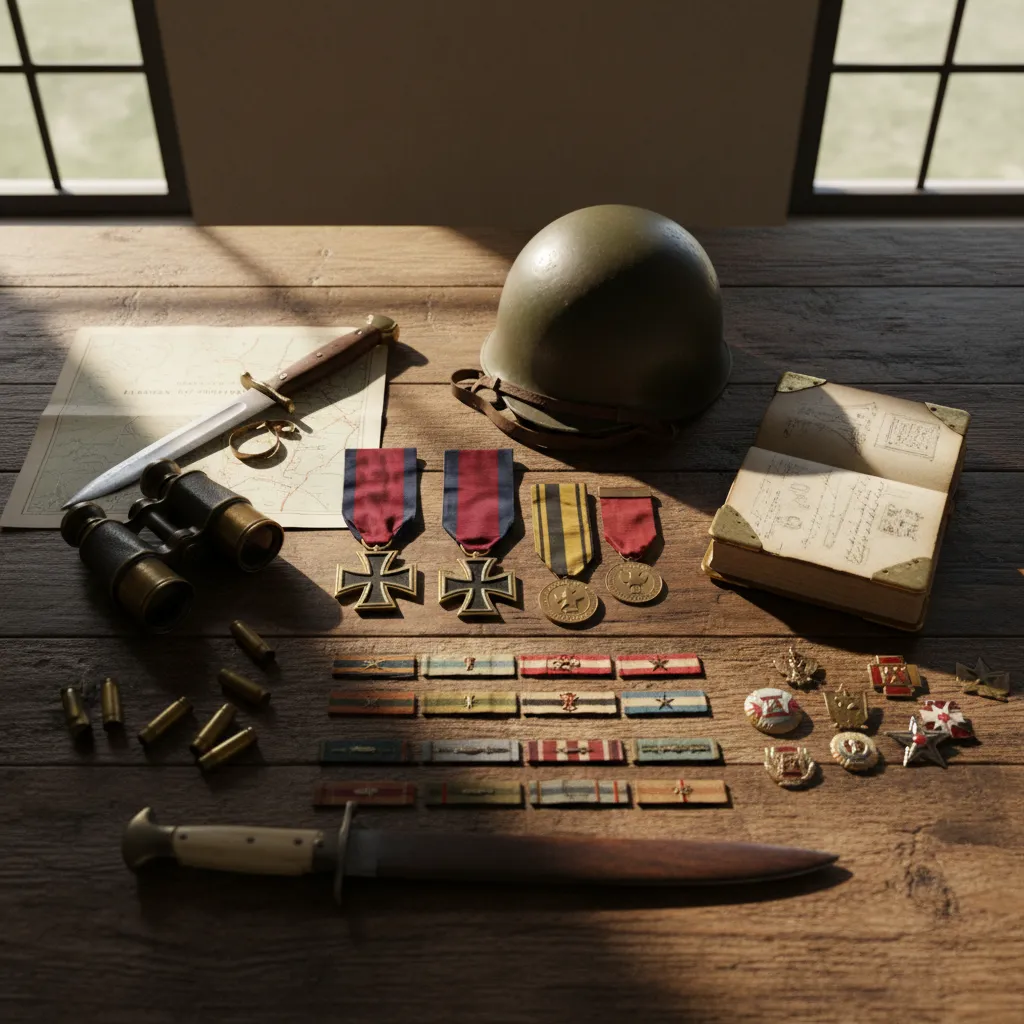
AppraiseItNow appraises militaria spanning multiple conflicts, nations, and eras. Our appraisers evaluate:
- Medals, decorations, and orders (American, European, and foreign awards)
- Edged weapons including swords, bayonets, and daggers
- Military firearms and pistols (subject to applicable legal requirements)
- Uniforms, headgear, and insignia
- Helmets and body armor from WWI through modern conflicts
- Flags, banners, and regimental colors
- Military artwork, maps, and wartime photography
- Battlefield relics and trench art
- Wartime documents, letters, diaries, and discharge papers
- Named or attributed items with provenance to specific individuals or units
Who Does AppraiseItNow Serve?
AppraiseItNow serves private collectors, veterans' families, estate attorneys, and CPAs who need credible militaria valuations for tax, legal, or insurance purposes, as well as donors contributing items to museums, historical societies, or veteran organizations.
5-Star Valuation Services, Loved by Hundreds
{{sectionName}}

{{sectionName}}
{{sectionName}}
{{sectionName}}
.svg)
View all Locations
How our Valuation Process Works
Written USPAP-compliant personal property appraisals for when defensibility matters.
Given the USPAP-compliant nature of AppraiseItNow’s appraisal reports, we prepare our deliverables for major legal, tax, and financial reporting purposes for individual and commercial clients.
Popular uses of our appraisal reports include:
Taxes, Estates & Financial Planning
- Gift Tax - IRS Form 709
- Estate Tax - IRS Form 706
- Charitable Donations - IRS Form 8283
- Estate planning, equitable distribution, and probate
- Loan Purposes
Life Events & Special Circumstances
- Divorce
- Social Security reporting or Medicaid Application Filings
- E-2 visa applications
Insurance & Risk Management
- Insurance coverage
- Insurance claims
- Third-party & legal damage claims
What types of militaria does AppraiseItNow appraise?
AppraiseItNow appraises a wide range of military collectibles and artifacts spanning multiple eras and nations. Our appraisers handle items including:
- Uniforms, helmets, and field gear
- Medals, decorations, and insignia
- Edged weapons such as swords, bayonets, and daggers
- Military firearms and pistols
- Flags, banners, and unit standards
- Maps, documents, letters, and photographs
- Canteens, mess kits, and personal effects
- Vehicles, artillery, and large equipment (by arrangement)
We appraise items from the American Civil War, World Wars I and II, Korea, Vietnam, and other conflicts, as well as foreign militaria from Allied and Axis nations.
Are your militaria appraisals USPAP-compliant?
Yes. All AppraiseItNow militaria appraisals are prepared in compliance with USPAP Standards 7 and 8, which govern the development and reporting of personal property appraisals. Standard 7 requires appraisers to develop credible results through accepted research and analytical methods, while Standard 8 mandates clear and non-misleading reporting. Our reports are defensible for use with the IRS, insurance carriers, courts, and estate attorneys.
What are common reasons someone needs a militaria appraisal?
Collectors, families, and estates seek militaria appraisals for a variety of legal, financial, and personal purposes, including:
- Insurance coverage to establish replacement value for scheduled items
- Estate settlement and probate requiring fair market value at date of death
- Charitable donation deductions requiring a qualified appraisal for contributions over $5,000
- Divorce proceedings requiring an independent valuation for equitable distribution
- Sale or auction consignment to establish a realistic market value opinion
- Capital gains tax reporting on items sold after inheritance
- Loan collateral or bankruptcy filings
Can you appraise militaria in poor condition, with unknown provenance, or with limited documentation?
Yes, and this is actually one of the most common situations our appraisers encounter. Condition and provenance are key value factors, so an appraiser will note wear, repairs, and missing documentation as part of the valuation rather than as disqualifying issues. It is worth knowing that roughly 70% of claimed family heirlooms turn out to be post-war souvenirs worth 10 to 20% of genuine period items, so an honest assessment of authenticity protects you from IRS donation disallowances or overpayment on insurance premiums. Our appraisers use tools such as black light testing for leather repairs and density testing to distinguish period materials from reproductions.
Can you appraise large collections or multiple pieces?
Yes. AppraiseItNow regularly appraises small accumulations, mid-size collections, and large estate holdings containing dozens or hundreds of militaria items. Volume pricing is available for collections of 10 or more items, and discounted rates apply for collections of 50 to 100 or more pieces. For very large or complex collections, we can coordinate an onsite inspection with a qualified appraiser anywhere in the US.
Do you provide online or remote militaria appraisals?
Most militaria appraisals are completed remotely using photographs, descriptions, and supporting documentation you submit through our platform. Remote appraisals are accurate and fully USPAP-compliant for the vast majority of items. For larger projects, complex collections, or situations where physical inspection is required by scope or purpose, we can coordinate an in-person appraiser in any state across the US.
How much does a militaria appraisal cost?
Appraisal fees depend on the purpose and scope of the engagement. Standard appraisals for insurance coverage, personal use, probate, and estate distribution start at $195. Advanced appraisals for charitable donations, estate tax, insurance claims, divorce, and legal proceedings start at $295. Volume pricing by collection size is as follows:
- 1 item: $195 to $495
- 10 items: $695 to $1,200
- 50 to 100 or more items: $1,600 to $3,500 or more
All fees are quoted as a fixed price before work begins so there are no surprises.
Do you offer discounted pricing for large volumes?
Yes. Collections of 10 or more militaria items qualify for small collection pricing, and collections of 50 to 100 or more items receive further discounted rates. This makes it practical to appraise an entire estate or inherited collection in a single engagement rather than paying single-item rates for each piece. Contact us to discuss your collection size and we will provide a fixed quote before any work begins.
How long does a militaria appraisal take?
Most remote militaria appraisals are completed within 7 to 10 business days from the time all required information and photographs are received. Onsite inspections or larger collections typically take 2 to 3 weeks to complete. If you have a deadline for an estate filing, insurance claim, or auction consignment, rush service is available for same-day or next-day turnaround upon request.
Who prepares the appraisal report?
Reports are prepared by credentialed personal property appraisers with expertise in militaria and antiques. Each appraiser follows USPAP Standards 7 and 8 and applies accepted methodologies including sales comparison analysis using verified hammer prices from sources such as Heritage Auctions and Rock Island Auction Company. The report includes the appraiser's qualifications, signature, and identification number as required for IRS-qualified appraisals.
Are your appraisers ISA, ASA, or AAA credentialed?
Yes. AppraiseItNow's personal property appraisers hold credentials from recognized bodies including the International Society of Appraisers (ISA) and the American Society of Appraisers (ASA). The ISA has specialists with militaria expertise, and the Appraisers Association of America (AAA) also credentials appraisers in antiques and militaria. All appraisers must demonstrate competency in the specific category being appraised as required by USPAP's Competency Rule.
Do you prepare appraisals for IRS Form 8283 (Noncash Charitable Contributions)?
Yes. When you donate militaria to a qualifying organization and the claimed value exceeds $5,000, IRS rules require a qualified appraisal attached to Form 8283 Section B. The appraisal must be completed no earlier than 60 days before the donation and no later than the tax return filing date, and it must include the appraiser's declaration, qualifications, and ID number. AppraiseItNow's reports meet all of these requirements, and our appraisers have no financial interest in the donated property, which is a separate IRS condition for qualification.
Do you prepare appraisals for IRS Form 706 (Estate Tax)?
Yes. If a decedent's gross estate exceeds the federal exemption threshold, currently $13.61 million for 2024, Form 706 requires fair market value appraisals for personal property including militaria. Even for estates below that threshold, a date-of-death appraisal establishes the stepped-up cost basis that heirs use to calculate capital gains when items are later sold. AppraiseItNow prepares USPAP-compliant reports suitable for Form 706 filings and the supporting schedules required by estate attorneys and CPAs.
Do you buy, sell, or broker militaria?
No. AppraiseItNow is an independent appraisal firm and does not buy, sell, or broker militaria under any circumstances. This independence is a legal requirement for IRS-qualified appraisals and ensures that our valuations are unbiased and defensible. If you are looking to sell, we can provide a fair market value opinion that you can take to auction houses or dealers.
What information do you need to get started?
To begin a militaria appraisal, it helps to provide as much of the following as possible:
- Clear photographs from multiple angles, including any markings, stamps, or serial numbers
- A description of the item including type, country of origin, and estimated era
- Any provenance documentation such as veteran letters, discharge papers, or purchase receipts
- Manufacturer marks, unit insignia, or other identifying features you can identify
- The intended purpose of the appraisal, such as insurance, estate, or donation
- Any prior appraisals, auction estimates, or purchase records
You do not need complete documentation to get started. Our appraisers will work with whatever information is available.
Can AppraiseItNow appraise militaria located anywhere in the U.S.?
Yes. Remote appraisals are available to clients in all 50 states, and the majority of militaria appraisals are completed entirely online using submitted photographs and documentation. For larger collections, complex estates, or situations requiring physical inspection, we can coordinate an in-person appraiser in any state. Geographic location does not limit your access to a qualified, USPAP-compliant appraisal.
Will my appraisal be accepted by the IRS, insurers, or courts?
AppraiseItNow's reports are prepared to meet the standards required by the IRS, insurance carriers, probate courts, and legal proceedings. Our appraisals are USPAP-compliant, prepared by credentialed appraisers, and include all elements required for a qualified appraisal under IRS regulations, including the appraiser's declaration, qualifications, and identification number. Overvaluation penalties of 20 to 40% can apply when IRS-determined values differ significantly from reported values, which is one reason our appraisers rely on verified auction hammer prices rather than asking prices or unverified online listings.
Does the age or nationality of militaria affect how it is appraised or whether it can be legally donated or sold?
Yes, and this is an important nuance that affects both value and legal compliance. Nazi-era militaria such as SS daggers and certain Axis insignia may be subject to import and export restrictions under the International Traffic in Arms Regulations (ITAR), and US appraisers are expected to note cultural property status per State Department guidelines, which can affect interstate transport values. An appraiser will flag these issues in the report so that donors, estate executors, and sellers can consult legal counsel before proceeding.
How does condition affect militaria value, and does restoration hurt or help?
Condition is one of the most significant value drivers in militaria, but the effect of restoration depends heavily on the item type. Restored firearms typically lose 30 to 50% of their collector premium compared to unrestored examples in comparable condition, because originality is highly prized. Conversely, battle damage on helmets or unit-specific markings can actually double value relative to unmarked examples of the same model, and appraisers use paired sales analysis to quantify these differences using recent auction records.
How do appraisers detect fakes or reproductions in militaria, and how common is the problem?
Authentication is a core part of every militaria appraisal because the reproduction market is substantial. Appraisers use methods including black light testing to reveal invisible repairs on leather gear, density testing to distinguish period bakelite from modern plastic badges, UV examination of dyes on uniforms, and borescopes for firearm bores. The post-2020 collector surge drove a flood of European Axis reproductions into the market, contributing to a roughly 25% drop in average helmet values due to authentication distrust, which makes professional verification especially important before insuring, donating, or selling any significant piece.
APPRAISEITNOW APPRAISERS ARE BEST-IN-CLASS & CREDENTIALED BY LEADING APPRAISAL ORGANIZATIONS LIKE THE ISA, ASA, & MORE.




