
Donating tickets to a sold-out show or a season-ticket package to your favorite team feels like a simple act of generosity, but the IRS treats it as a noncash charitable contribution with its own valuation rules. Once the claimed deduction crosses certain dollar thresholds, you need documentation, and eventually a qualified appraisal, before the IRS will honor the deduction. This guide walks through when a concert ticket donation appraisal is required, how fair market value is actually calculated, and how season tickets, suites, and personal seat licenses fit into the picture.
When Does a Concert Ticket Donation Need an Appraisal?
A concert ticket donation needs a qualified appraisal once the claimed deduction for the tickets exceeds $5,000. Below that line, different but still specific documentation rules apply, and the amounts stack in a predictable order.
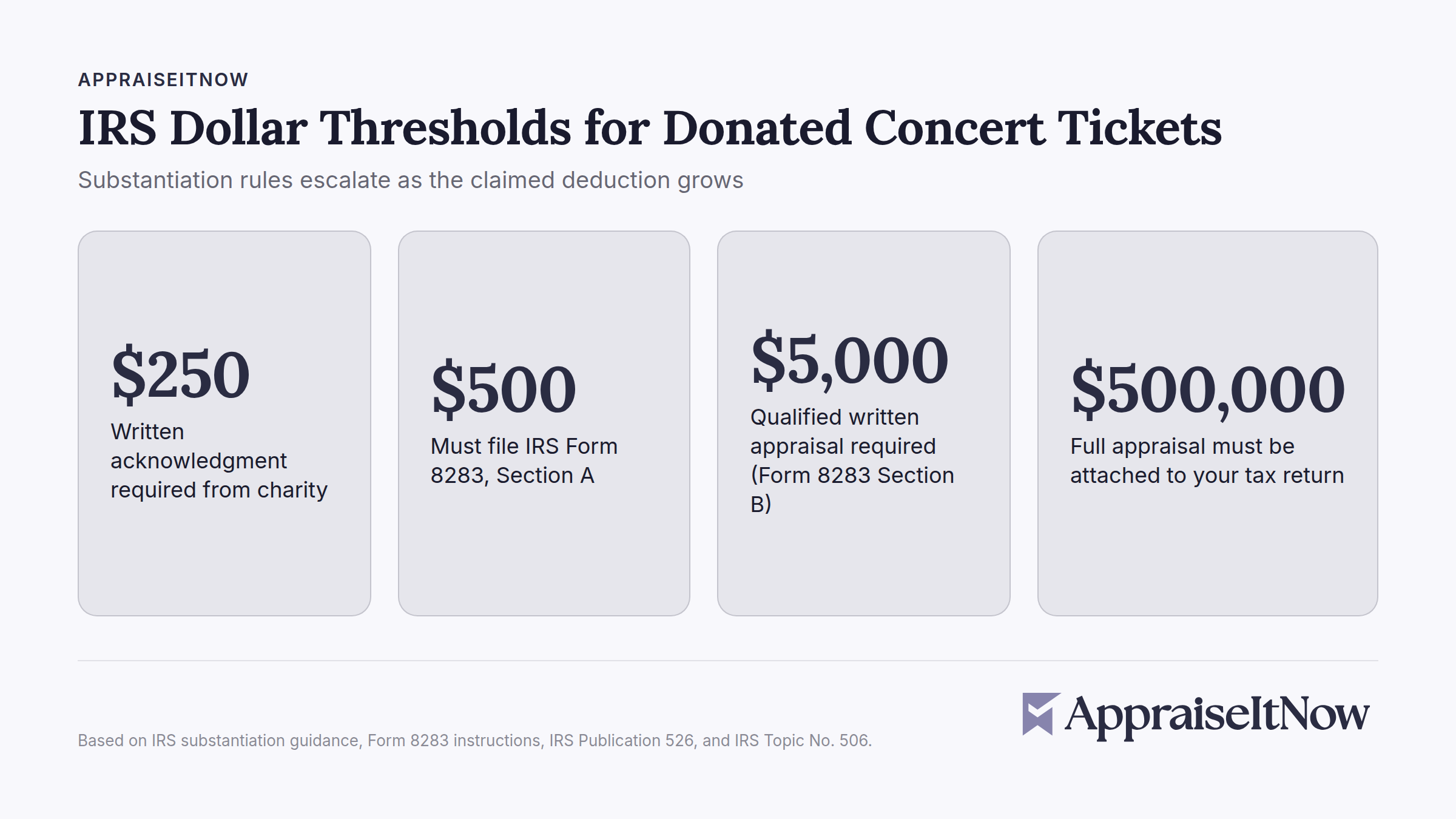
Donated tickets are noncash property, so they follow the same substantiation ladder as any other charitable gift of property:
- Over $250: the charity must give you a contemporaneous written acknowledgment describing the gift and, if you received anything in return, a good faith estimate of the value of that benefit, per IRS substantiation guidance.
- Over $500: you must file IRS Form 8283 with your tax return, using Section A for the tickets.
- Over $5,000: the tickets move to Form 8283 Section B, and you must obtain a qualified written appraisal from a qualified appraiser, per the Form 8283 instructions and IRS Publication 526.
- Over $500,000: the qualified appraisal itself must be attached to your return, not just summarized on Form 8283, according to IRS Topic No. 506.
A single high-demand concert ticket rarely crosses $5,000 on its own, but a season-ticket package, a block of tickets to the same event, or a suite license routinely does. Once you're near that line, an appraisal isn't optional paperwork; it's what stands between your deduction and an IRS challenge.
Ordinary Income Property vs Capital Gain Property: How Much You Can Deduct
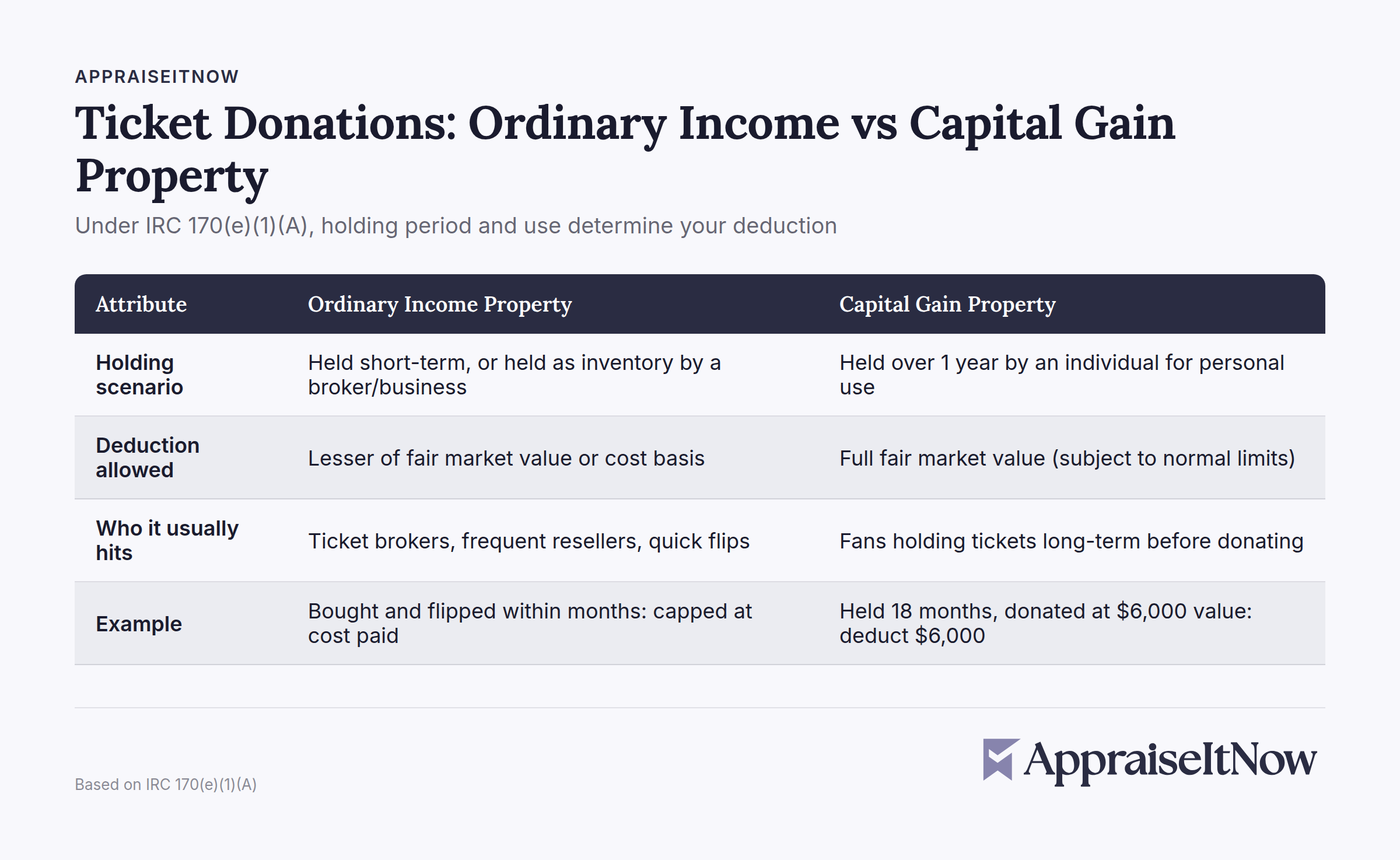
How much of the ticket's fair market value you can actually deduct depends on what kind of property the tickets are in your hands, not just what they're worth. This distinction, drawn from IRC 170(e)(1)(A), is one of the most misunderstood parts of a ticket donation.
The test asks a simple question: if you had sold the tickets for fair market value on the day you donated them instead, would that sale have produced ordinary income or short-term capital gain?
- If yes (the tickets were held short-term, or you're a ticket broker or business holding them as inventory), the property is treated as ordinary income property, and your deduction is limited to the lesser of fair market value or your cost basis.
- If no (an individual held the tickets for personal use for more than a year before donating), the tickets generally qualify as capital gain property, and you can deduct the full fair market value.
Example: A fan buys two floor seats to a concert eighteen months before the show and later donates them to a charity auction when the secondary market value has climbed to $6,000. Because the seats were held over a year for personal use, they're capital gain property, and the fan can generally claim the full $6,000 fair market value, subject to normal deduction limits. If that same fan had bought and flipped the tickets within a few months, the deduction would be capped at whatever was paid for them.
This rule catches ticket brokers and frequent resellers most often, since inventory tickets almost always fall on the ordinary income side of the line regardless of how much time has passed.
How Is Fair Market Value Determined for Donated Tickets?
Fair market value for a donated ticket is set by what a willing buyer would pay a willing seller in the secondary market for that specific seat, on the date of the donation, not by the price printed on the ticket. Face value is almost always irrelevant once a show or game has generated resale demand.
IRS Publication 561 lays out the general fair market value framework the IRS applies to donated property, and appraisers apply that same standard to tickets by looking at secondary-market data for comparable seats to the same event or, for season packages, comparable resale listings for that team or venue. A qualified appraisal for tickets typically documents:
- The specific event, date, venue, and seat location or section
- The quantity of tickets or the scope of the season package
- Whether the tickets are transferable, and any restrictions on resale
- Comparable secondary-market sales or listings as of the contribution date
- The valuation method used to arrive at the concluded fair market value
Because secondary-market prices for tickets can swing sharply based on team performance, opponent, setlist rumors, or weather, the valuation date matters enormously. An appraisal completed even a few weeks after the actual donation date can produce a materially different number, which is why appraisers work from contemporaneous market data tied to the exact contribution date whenever possible.
Season Tickets, Suites, and Personal Seat Licenses: Special Cases
Season tickets, suite licenses, and personal seat licenses can all be donated, but they're usually valued as intangible personal property, a bundle of contractual rights, rather than as physical tickets. That distinction changes how the appraisal is built, even though the same IRS thresholds and forms apply.
- Season tickets: A full season package is valued as a group. Comparable sales data comes from secondary markets for season-ticket rights to that team or artist series, not from single-game resale prices alone, since the renewal rights and priority seating attached to a season package carry their own value.
- Personal seat licenses (PSLs): A PSL grants the right to purchase season tickets in a specific seat, and that right itself has a resale market independent of the tickets. When a donor gives away a PSL, the appraisal values the license and any attached ticket rights together.
- Suite and box licenses: Corporate or luxury suite rights are typically long-term contractual arrangements. Valuing a donated suite license requires looking at what comparable suite rights sell for in that venue's private resale market, plus any remaining term on the license.
- Single-event tickets: A block of tickets to one concert or game is the simplest case, valued against secondary-market comparables for that exact date and seating section.
A season-ticket package or a block of concert tickets to the same event can be treated as similar items of property and grouped on a single appraisal and a single Form 8283 for that donee, which keeps the paperwork manageable even when a donor gives multiple ticket types to the same charity in one tax year.
Donating Tickets vs Paying for a Charity Gala Seat
Donating tickets you already own is a different transaction from buying a seat at a charity's own fundraising gala, and the IRS treats the deduction very differently in each case.
When you donate tickets you own to a charity (so the charity can use them or resell them), the deduction is based on the fair market value of the tickets themselves, subject to the ordinary income vs capital gain rules above. When you pay for a ticket to a charity's own event, such as a gala dinner or a benefit concert the charity is hosting, IRS Publication 526 is explicit that you can only deduct the amount you paid in excess of the fair market value of what you received (the meal, entertainment, or seat itself). If a $500 gala ticket includes a dinner worth $150, the deductible portion is $350, not $500.
A related principle shows up in older IRS guidance on charitable gifts: when a donor receives something of value in exchange for a payment, Revenue Ruling 67-246 holds that the deductible gift is limited to the amount paid in excess of the value of that consideration. Ticket donors sometimes conflate the two scenarios and overstate a gala-ticket deduction, or understate an owned-ticket donation by using face value instead of resale value. Both mistakes draw IRS scrutiny.
What a Concert Ticket Donation Appraisal From AppraiseItNow Includes
AppraiseItNow prepares USPAP-compliant qualified appraisals for donated concert tickets, sports tickets, season-ticket packages, suite licenses, and personal seat licenses, built to support IRS Form 8283 Section B filings. Because every engagement depends on the event, the seat type, the number of tickets, and whether the property is intangible (a season or suite license) or a straightforward block of single-event tickets, the fee for a ticket donation appraisal is quoted as a fixed fee after we scope the assignment, never billed hourly and never estimated off a generic price list.
Our reports are prepared in accordance with USPAP (the Uniform Standards of Professional Appraisal Practice, published by The Appraisal Foundation) and document the comparable secondary-market data, valuation method, and contribution-date analysis the IRS expects to see behind a ticket valuation. For donors handling related estate or memorabilia holdings alongside a ticket donation, our team also prepares appraisals across personal property categories that often surface in the same estate or donation review.
Getting the Deduction Right Before You File
The most common mistake in a concert ticket donation is using face value or an old purchase price instead of the actual secondary-market value on the day of the gift. The second most common mistake is skipping the appraisal because a single ticket felt too ordinary to need one, only to discover a season package or grouped block of tickets pushed the deduction well past $5,000. Getting the fair market value, the holding-period analysis, and the Form 8283 paperwork right before you file protects the deduction instead of inviting a dispute after the fact.
This article is provided for general informational purposes only and does not constitute legal, tax, or financial advice. Readers should consult a qualified attorney or CPA regarding their specific circumstances.