
Insurance Appraisal of Sports Trading Card Collection
Sports trading card appraisal for insurance claim support, covering graded modern cards, ungraded vintage issues and multi-sport collections valued at retail replacement cost. AppraiseItNow appraised a New Mexico card collection from owner photographs, reconciling graded-market references and retail marketplace listings into replacement-cost conclusions.
Project Overview
Assignment Summary
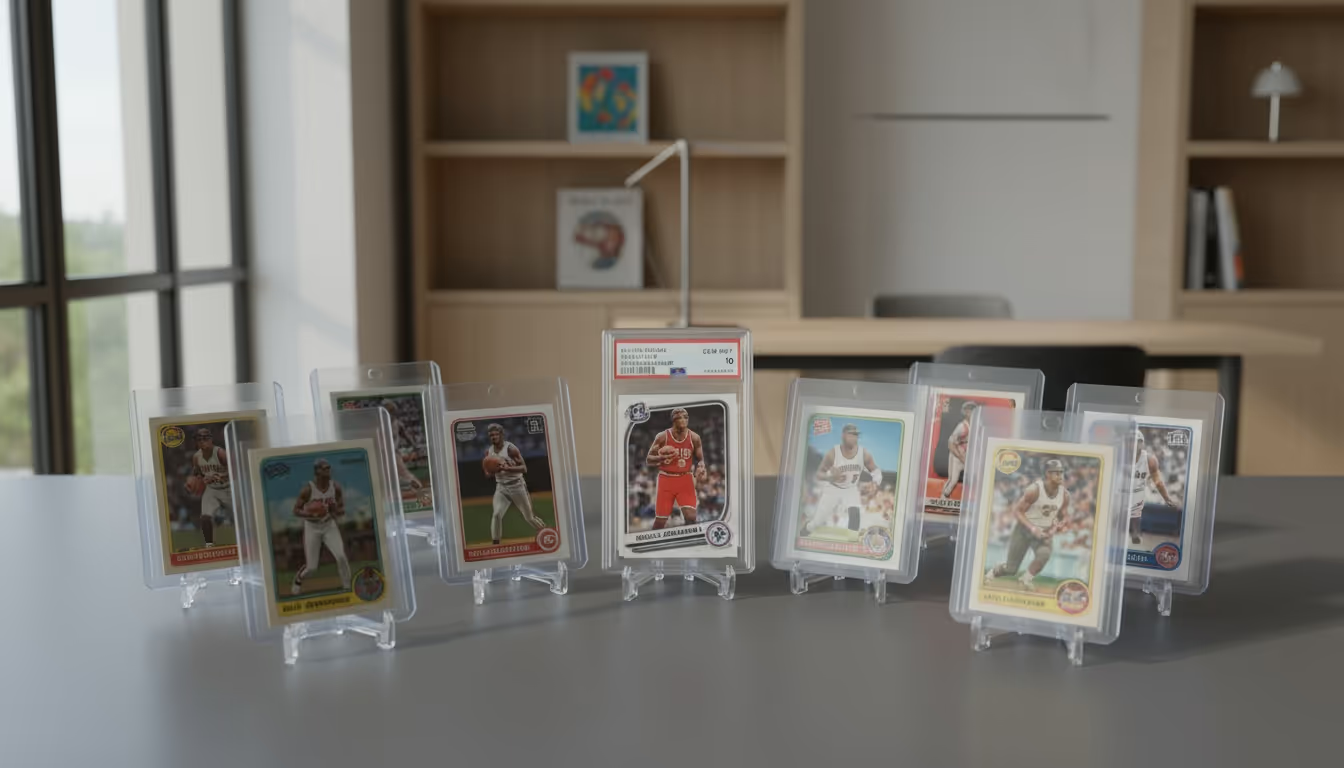
The assignment required determining retail replacement values for a collection of sports trading cards for the sole purpose of supporting an insurance claim. The scope of work included identifying items from photographs, researching relevant retail marketplace data, and reconciling comparable retail offerings to reach replacement-cost conclusions. Subject assets included graded contemporary cards and ungraded vintage cards from various sports. The appraisal was prepared in conformity with USPAP and delivered as an Appraisal Report with supporting market commentary and photography, focusing on what it would cost a typical buyer to replace each item in the current retail market.
Challenges
Our Approach
Project Outcome
Ready to start your appraisal?
Tell us the asset and what the value is for, and we will confirm scope, timing, and a fixed fee before any work begins.
Request an AppraisalFrequently Asked Questions
How does grading change the replacement cost of a trading card?
Enormously, and non-linearly. The same card in adjacent grades from a major grading service can differ by multiples, and the gap widens at the top of the scale. Replacing a graded card means buying another example in the same grade from the same service, so the appraisal works from graded-market sales for that exact combination rather than from raw card pricing.
Can an ungraded vintage card be valued reliably from photographs?
Within a range, and the range is wide. Centering and obvious surface damage are visible in a good photograph, but corner sharpness, edge wear and any trimming or restoration are not reliably assessable without the card in hand. The appraisal states an assumed condition band and reports value against it, so the adjuster can see how sensitive the figure is to that assumption.
What is the difference between a variation and a misprint?
A recognized variation is a documented, catalogued difference the market prices as a distinct card; a misprint is a random production error whose value depends entirely on collector interest in that specific flaw. Misdescribing one as the other is common in listings and it moves value in both directions. Verifying the classification against catalog references is part of the identification work.
Should a collection be scheduled individually on an insurance policy?
High-value cards generally should be. Blanket contents coverage often carries sub-limits for collectibles that fall far below what a serious collection is worth, and a scheduled item is valued at an agreed figure rather than argued after the loss. An appraisal is what the carrier needs to schedule it, and it is far easier to obtain before a loss than after.